

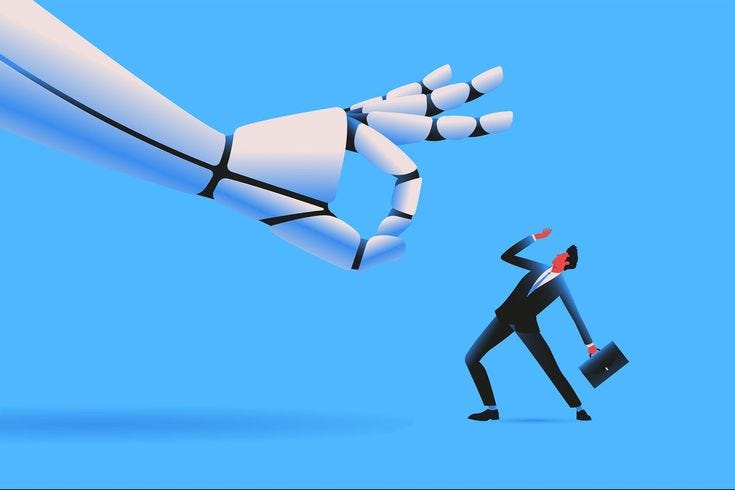
Sorry to break it to you, but I think we have become a little too obsessed with keeping humans in the loop. Every discussion about autonomous AI eventually reaches the reassuring conclusion that humans will always supervise the important decisions. It sounds responsible, but I suspect we use human supervision to compensate for systems not properly designed for autonomy.
My research in AI suggests that humans should increasingly sit at governance, defining objectives, permissions, risks, and operating limits. They should intervene when decisions genuinely exceed the authority already delegated. But requiring human approval during routine execution makes little technical sense, and in customer care and sales, I would argue it can actually make the experience worse.
Technically, human-in-the-loop does not scale
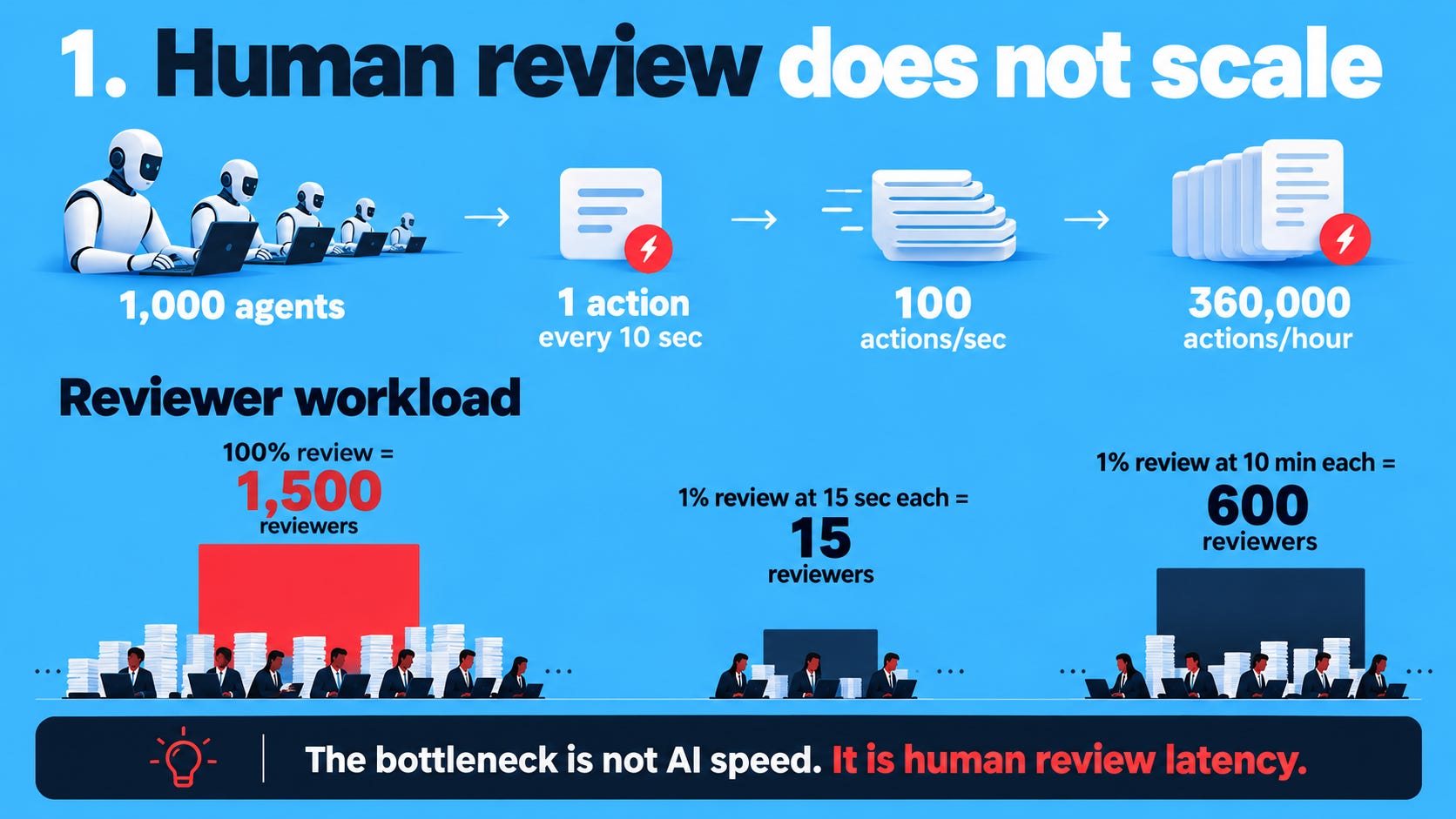
Imagine a system running 1,000 AI agents, each proposing an action every ten seconds. That produces 100 actions per second, or 360,000 per hour. If a person needs 15 seconds to review each action, you would need 1,500 people reviewing continuously just to keep up. No breaks, no complicated cases, and no allowance for sudden increases in activity.
Even reviewing only 1% of those actions means 3,600 decisions per hour. At 15 seconds per decision, that requires 15 people continuously reviewing. But exceptional decisions are usually more complicated. If each takes ten minutes, you suddenly need 600 reviewers. These are hypothetical assumptions, but the arithmetic shows how quickly human supervision becomes an operational bottleneck.
And what exactly does human reviewing entail?
Imagine five agents investigating an outage, analyzing thousands of telemetry points, exchanging information, and creating temporary specialist agents. After hundreds of operations, they recommend a corrective action. An engineer might read the recommendation in 30 seconds, but independently validating the reasoning could take hours. Clicking approve does not mean the person actually verified anything.
There is also the problem of speed. Your car’s airbag deploys in milliseconds because human intervention would be useless. Obviously, an airbag controller is much simpler than an autonomous AI system, but the physical limitation remains. When a failure develops faster than a person can understand and respond, human approval cannot be the primary protection mechanism.
What research tells us about human supervision

This is not a new problem. In 1983, Lisanne Bainbridge published Ironies of Automation, explaining how automation can make the remaining human responsibilities more difficult. Operators gradually lose familiarity with routine operations while remaining responsible for unusual failures. When something goes wrong, the person least involved in the preceding activity must suddenly reconstruct the situation and make the correct decision.