

Next week, investors will be asked to value Jio Platforms at about $108 billion. The company has 533 million mobile customers, generates almost all its revenue in India, and collects an average of just $2.27 per mobile customer per month. Those aren't the numbers you'd normally associate with one of the world’s most valuable telecom companies.
But Mukesh Ambani isn't simply selling a mobile operator story. Instead, he is selling the possibility of a national digital platform built on a mobile network: AI, cloud, entertainment, enterprise software, connected homes, and distribution for some of the world's largest technology companies. If that works, the network becomes the entry ticket, not the final product. And Jio might become the example other telcos have spent twenty years talking about without delivering.
The question is whether investors are already paying for that platform or just for an exceptionally good telecom business.
Half a billion customers, one country
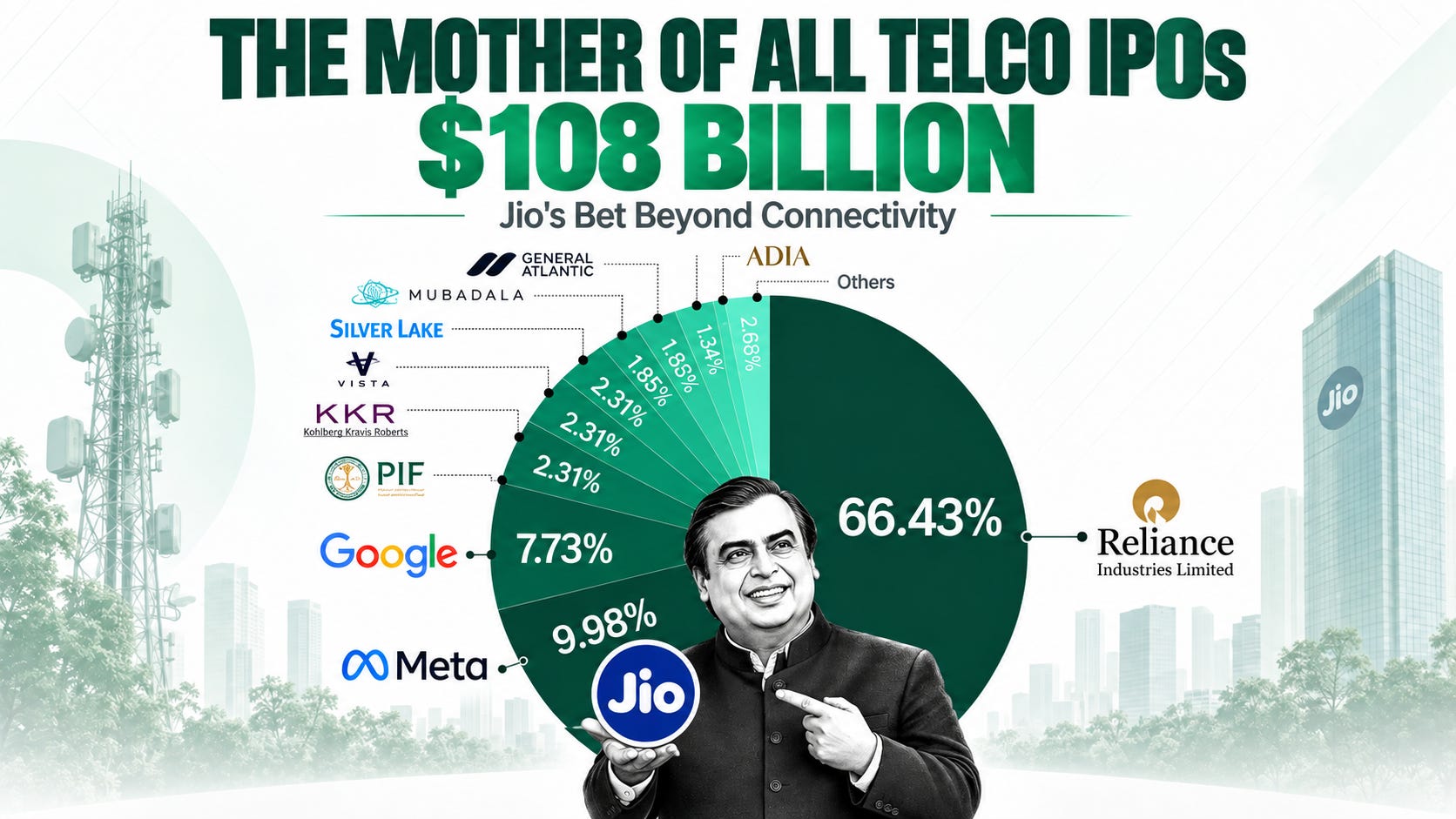
The IPO opens October 21, closes October 23, and is expected to begin trading October 28. At approximately $11.22 to $11.78 per share, Jio would be worth about $108 billion at the top of the range and raise up to $3.18 billion. Only 2.9% of the company is being issued as new shares. Reliance Industries owns 66.43% before the offering, while Meta and Google hold 9.98% and 7.73%.
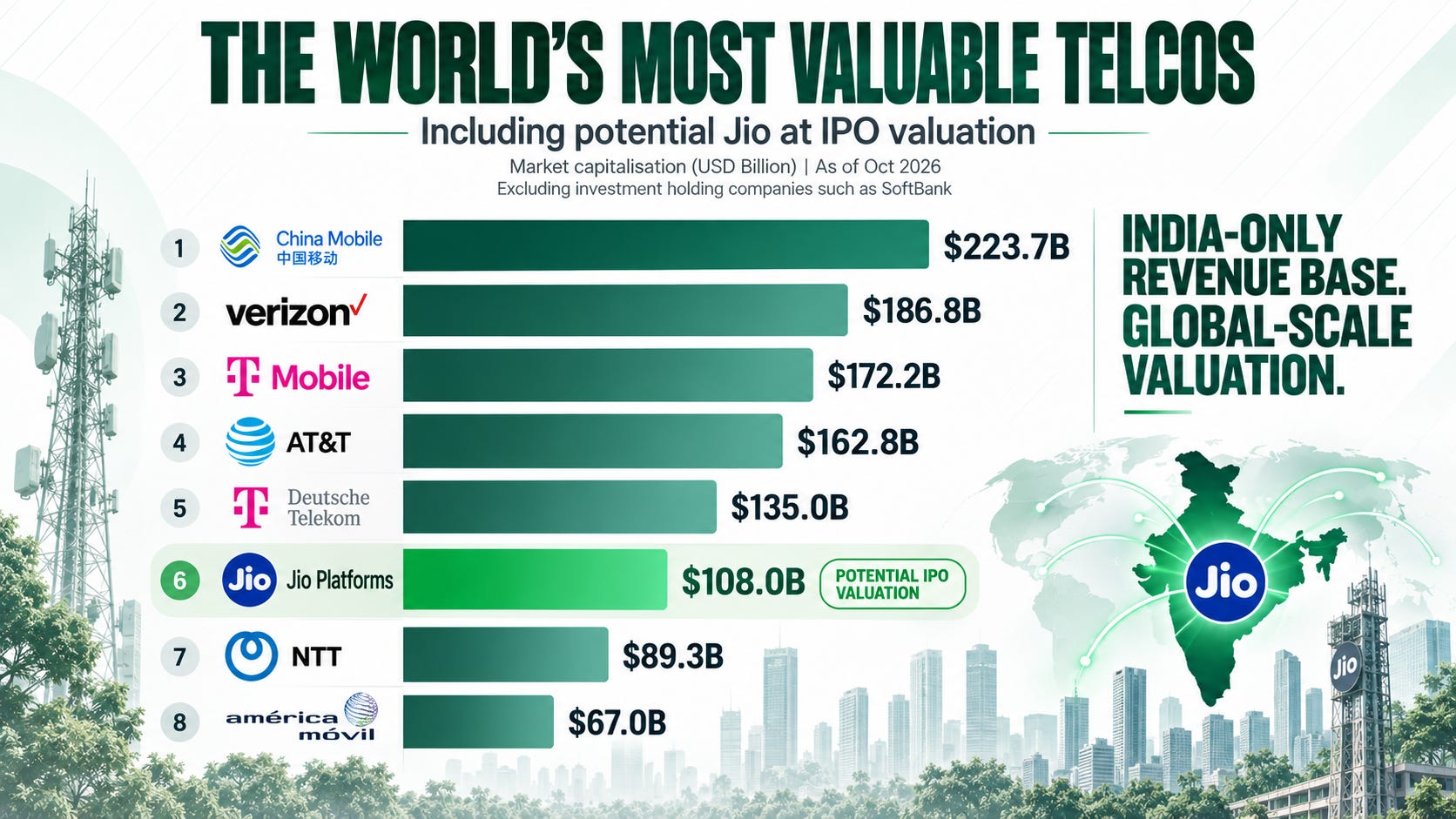
At that valuation, Jio would rank roughly seventh or eighth among the largest listed telecom groups, depending on which holding companies are included. More remarkably, 96.6% of its revenue comes from India. Deutsche Telekom owns T-Mobile US and operates across Europe. América Móvil has operations across Latin America. Jio has built this valuation overwhelmingly inside one country. That concentration brings risk, too. A change in Indian pricing, regulation or competition affects almost the entire business, while multinational operators can offset weakness in one market with profits elsewhere.
Of course India is an enormous country, and Jio’s scale is difficult to exaggerate. In June it had 533.3 million customers, including 284.9 million on 5G, plus 28.6 million fixed broadband subscribers. It carries around 60% of India’s wireless data traffic, while the average customer uses more than 43 GB per month. The network is already operating at national scale. The difficulty is converting that consumption into higher spending.