


Last week, at Qualcomm’s headquarters in San Diego, VP of Engineering Hemanth Sampath told a room of press and analysts that 50 GB a month is modest. He said a single personal AI assistant could consume around 45 GB a month, with half of it on the uplink; that a current 5G cell would support roughly five such users; and that 6G would raise that to twenty-plus. Durga Malladi, who runs technology planning and edge solutions, warned that if 6G ends up being just a more efficient bit pipe, then, in his words, “we have failed.” I agree with Malladi on the failure, but strongly disagree with using the road to get there.
I tried to understand how Qualcomm gets from a personal AI assistant consuming 45 GB a month to a 5G cell supporting only around five such users. I could not find the assumptions behind that calculation. Monthly consumption alone tells us very little about cell capacity without knowing peak data rates, how many users are active simultaneously, the uplink duty cycle, available spectrum, TDD configuration, spectral efficiency, and how much continuous video is included in the “see what I see” scenario. The five-user number may be reasonable under Qualcomm’s traffic model, but without those assumptions it is difficult to judge what it actually tells an operator about future capacity requirements.
At the same time, Qualcomm’s position in telecom infrastructure is changing. In July 2026, the company began withdrawing its FSM100 and FSM200 small-cell platforms from sale to new customers while preparing for a potentially much larger role in 6G infrastructure. Qualcomm is discussing integrated 6G-grade telco servers that combine CPUs, RAN acceleration, and AI processing, while its X100 already provides Layer 1 acceleration within virtualized RAN servers. Cristiano Amon told investors on 24 June 2026 that Qualcomm now spans power envelopes from below 2 milliwatts to around 200 kilowatts.
More interestingly, Amon said that future infrastructure will not only move bits but also generate tokens. I think that is the bigger idea. Yet much of the 6G discussion around AI immediately falls back on the language telecom knows best: more devices, more traffic, more spectrum, and more capacity.
We have heard this story before.
3G brought mobile Internet, 4G brought smartphones and video, 5G brought immersive applications, cloud gaming, XR, and billions of connected devices. Now that AI has arrived, within months we are turning it into another data tsunami. When higher network demand improves your economics, every technology transition tends to become a capacity problem. For operators, history suggests the more important question is who gets paid when that capacity is consumed.
Thirty Years of Traffic Growth and Very Little Revenue Growth
Fredrik Jungermann’s Tefficient analysis of 10 December 2025, built on reported data from 116 operators, found that operators have never had lower total service revenue per gigabyte than they have now. In the first half of 2025, 92% of markets saw data usage grow, while only 54% saw ARPU grow. Portugal’s revenue per gigabyte fell 27% year on year, and Greece recorded a 26% decline in full-year 2024. Cable.co.uk measured the global average retail price per gigabyte, which fell from $8.18 in 2019 to $2.59 in its 2023 survey.
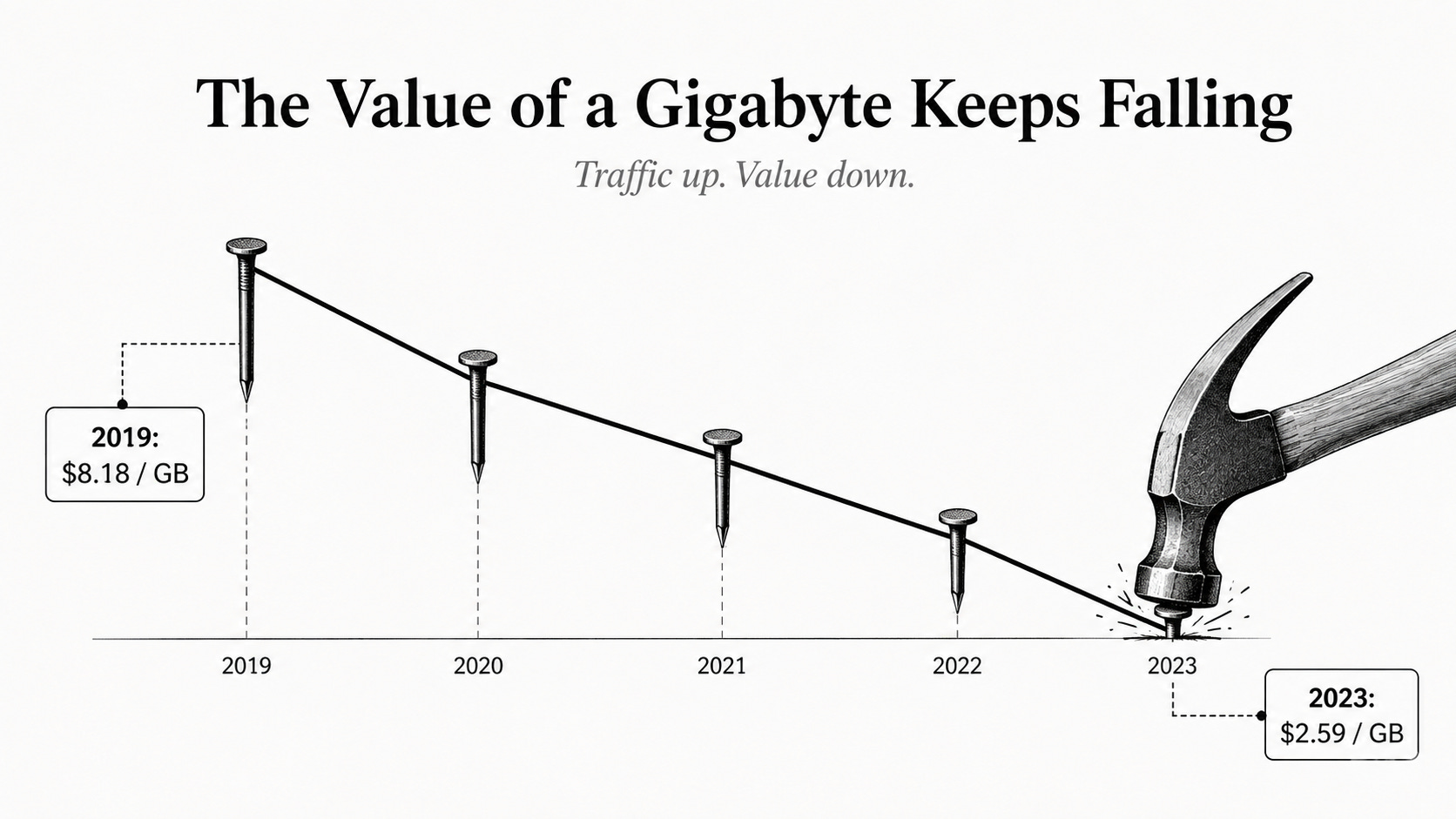
At the same time, Ericsson’s Mobility Report of 16 June 2026 measured global mobile data traffic growing 22% year on year to 210 exabytes a month. 22% annual growth would be extraordinary in almost any business. In telecom, this is happening while the economic value of the unit being transported continues to fall.
Even the equipment market has not followed the traffic curve.
Dell’Oro’s Stefan Pongratz reports the RAN market at 0% compound growth from 2020 to 2025 in nominal dollars, with nearly $9 billion in equipment revenue disappearing between 2022 and 2024. Dell’Oro forecasts roughly 1% annual growth through 2030. Traffic compounds in the twenties, revenue per gigabyte keeps falling, and the equipment market supposedly required to carry all those additional bytes is roughly flat over the cycle.
The industry’s last attempt to attach direct economic value to traffic growth also failed.
Timotheus Höttges told analysts in May 2026 that Deutsche Telekom was giving up on the fair-share debate after years of making little progress and receiving no political support. Europe’s largest operator could not convince policymakers that carrying more traffic entitled it to more money.
That history should make Telcos very careful about accepting AI as another volume story. If telcos allow the economic unit of AI to become the gigabyte, they have chosen to be paid in the one currency that has consistently deflated.
The rest of the technology industry is already thinking in different units. Amon is talking about tokens, Nvidia is selling accelerated compute, Hyperscalers are monetizing inference, and Model companies are selling intelligence.
Telcos cannot enter that economy and decide their role is to count the bytes moving between everyone else.