


The Telco Aspirin
Telecom’s Q2 2026 results carried a familiar prescription: fewer employees, lower operating costs, and a promise of better margins. AT&T reduced headcount by another 2,100 positions during the first half of 2026. Verizon removed roughly 2,000 roles since March, including 500 corporate jobs announced in July. O2 Germany confirmed plans to eliminate 1,100 positions, around 14% of its workforce. Nokia still appears to have more than 4,000 reductions left to complete under a program targeting €1.2 billion in annual savings.

None of these decisions is automatically irrational. Telecom still carries costs built for a different era: copper networks, physical retail, duplicated platforms, fragmented organizations and manual processes accumulated through decades of acquisitions. Automation can remove real work, Simplification can release capital, and Investors are entitled to expect management teams to operate efficiently.
The financial problem begins when workforce reduction becomes the main strategy.
A layoff program can improve EBITDA within months because the benefit is immediate and measurable. Revenue transformation takes longer, carries execution risk, and often requires additional investment before producing returns. Cost reduction therefore gives management the fastest route to a better quarter. But once the saving enters the earnings base, the effect stops growing. Without new revenue or higher returns on capital, the company must find another cost layer to remove.
That is why layoffs can become telecom’s aspirin. They relieve the pressure while leaving the underlying economics largely unchanged: traffic continues rising faster than revenue, connectivity remains difficult to differentiate, capital expenditure stays high, and many operators still earn returns close to or below their cost of capital.
It is true that Top Technology companies are also cutting thousands of jobs, but several are simultaneously redirecting far larger amounts toward AI infrastructure, product development and enterprise expansion. Microsoft, Meta, Amazon and Cisco are accepting investment risk in pursuit of larger future profit pools. Their bets may succeed or fail, but the released resources have an explicit destination.
That is the question telecom investors should ask after every restructuring announcement: Where will the savings go?
Cutting obsolete costs can strengthen a company. However, cutting people while preserving the same revenue model mainly makes the existing business smaller. The difference between efficiency and transformation is capital redeployment.
Telecom Is Getting Smaller Faster Than It Is Changing
Telcos’ latest reductions belong to a much longer restructuring cycle. AT&T and Verizon removed more than 179,000 positions between 2015 and 2022, almost 40% of their combined workforce at the start of that period. A further 51,500 positions disappeared after 2022. AT&T employed around 280,000 people in 2017 and had fallen to 141,000 by the beginning of 2025. Verizon eliminated 32,600 positions in the four years through 2024, while annual revenue increased by only $6.5 billion.
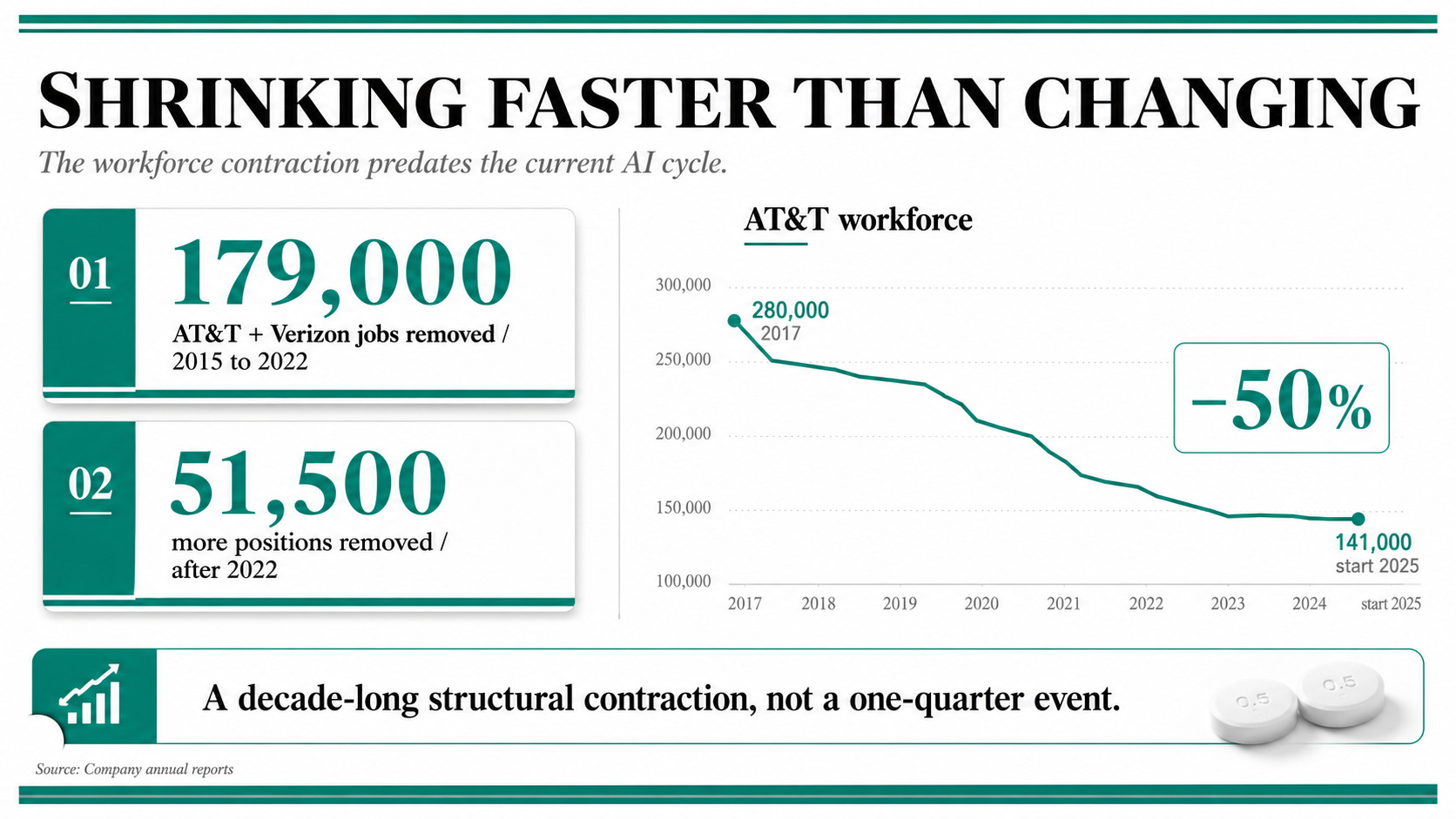
This is more than the removal of a temporary excess created by the pandemic, 5G deployment, Artificial intelligence, or a single economic downturn. Telecom has been reducing its workforce through several investment cycles, technology generations and management teams. Each program arrives with a slightly different label: simplification, digital transformation, operating model redesign, automation, portfolio optimization or, more recently, AI productivity. Nevertheless, the financial mechanism remains largely the same.
Removing employees reduces operating expenses faster than most commercial initiatives can increase revenue. Severance creates an immediate cash cost, but the recurring savings improve EBITDA in subsequent quarters. For a highly leveraged company with modest revenue growth, that improvement can support free cash flow, dividends, debt repayment, and earnings per share. Honestly, it is an entirely rational lever.