

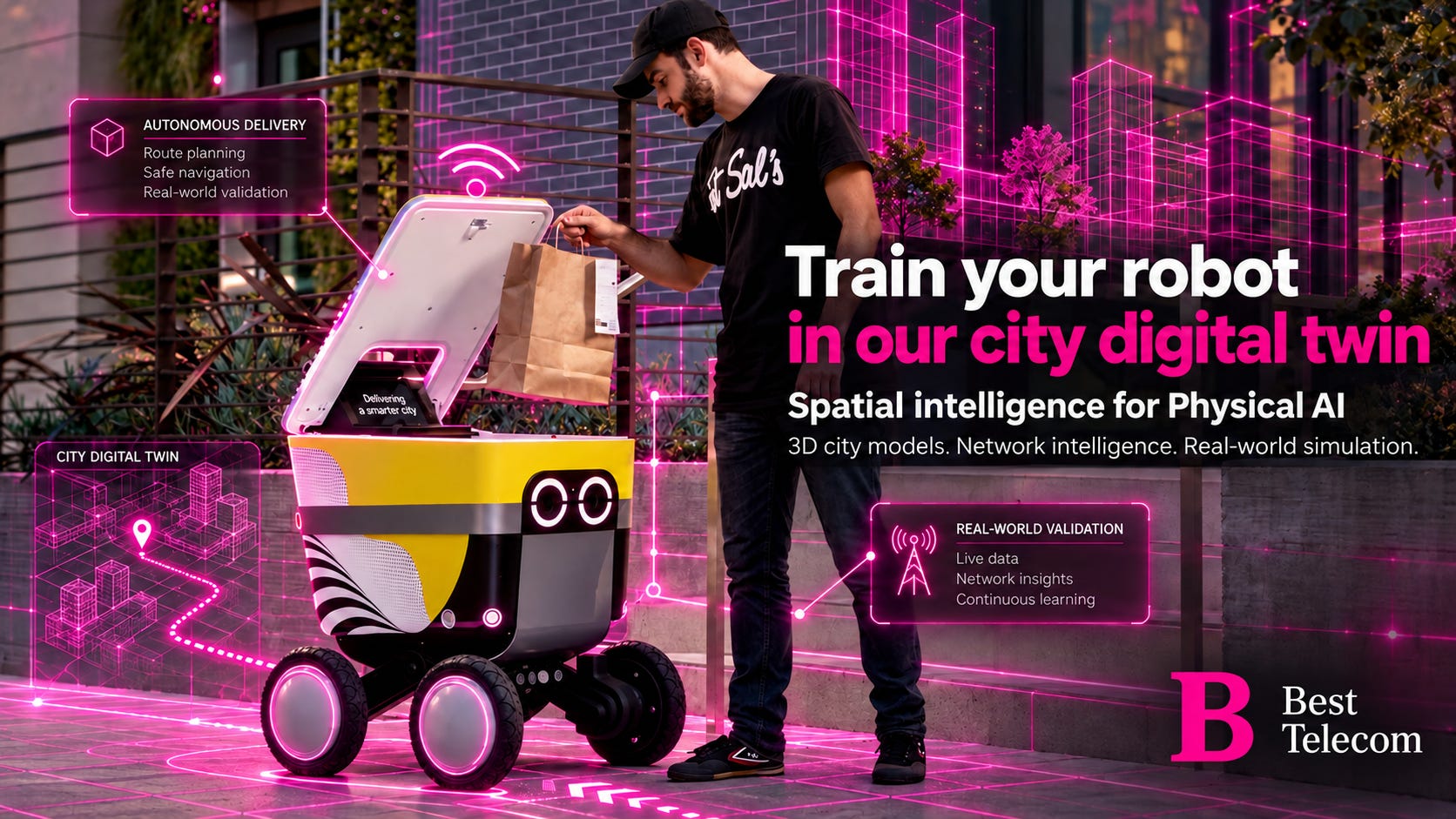
Over the past four months, I’ve advised several Physical AI companies on different topics, including communications. It’s given me an interesting perspective on an industry moving surprisingly fast. Delivery robots are navigating sidewalks, drones are inspecting infrastructure and delivering packages, and robotaxis are expanding into more cities. And these are only the first applications. Over the next decade, we could have millions of autonomous machines roaming around our cities, performing jobs that until recently required humans.
But there is an interesting question behind all this excitement. How the hell do you train all these little guys to operate in the real world?
A robot needs to understand streets, sidewalks, intersections, obstacles, pedestrians, traffic patterns, and thousands of situations it might encounter. And preferably before somebody sends it onto a busy street!
One approach is what Waymo has spent years developing, combining detailed mapping, enormous amounts of real driving data, and sophisticated simulation. By early 2026, Waymo had accumulated nearly 200 million fully autonomous miles, alongside billions of miles of simulated driving. This is an extraordinary engineering achievement, but how many robotics companies can afford to reproduce that level of investment every time they enter a new city? Probably very few.
A more scalable alternative would be to give robotics companies access to realistic digital representations of cities, where machines can train, simulate difficult situations, and validate their behavior before deployment. Once deployed, those same environments could provide updated information as streets, infrastructure and operating conditions change. The robots would still need their own sensors, intelligence, and real-world testing, but a shared digital city could significantly reduce the cost of preparing them.
And this is where I started thinking about telecom operators. Telcos have spent so many years building an extraordinarily detailed understanding of the physical world, almost exclusively to design and operate their networks. What if they could commercialize that knowledge as spatial intelligence for Physical AI?