


I am working with a Tier One telecom operator on its agentic AI strategy. Much of the work has nothing to do with choosing a model or buying more GPUs. We are trying to understand what the customer becomes when software starts making decisions, buying services, using networks, and acting with authority on somebody else’s behalf. Telecom has spent decades designing around humans holding phones and machines sending traffic.
The next customer may be an agent that sits between both.
Several pieces are already real. Agents can operate computers, retain memory, write software, use payment rails, and run across distributed inference infrastructure. Those are no longer research demos dressed up as strategy slides. They are shipping capabilities.
But the hot mess begins when you combine them. Give an agent memory, money, credentials, and enough autonomy to work for days, and suddenly reliability, identity, liability, verification, and security matter more than another benchmark point. A buggy chatbot is annoying. A buggy agent with a corporate card and production access is a financial disaster nobody wants to clean up.
I cannot share the details of the work, but I can share the ten shifts shaping it.
They cover agents that work longer, learn after deployment, build software, reason in new ways, delegate authority, trade with other agents, simulate outcomes, verify each other’s work, create new security risks, and eventually operate machines in the physical world. For telecom, the real issue is not whether agentic AI arrives. The issue is what kind of customer it creates, what that customer expects from the network, and who gets paid when machines start buying from machines.
10 Agentic AI Trends That Change Everything
1. Endless Work Agents
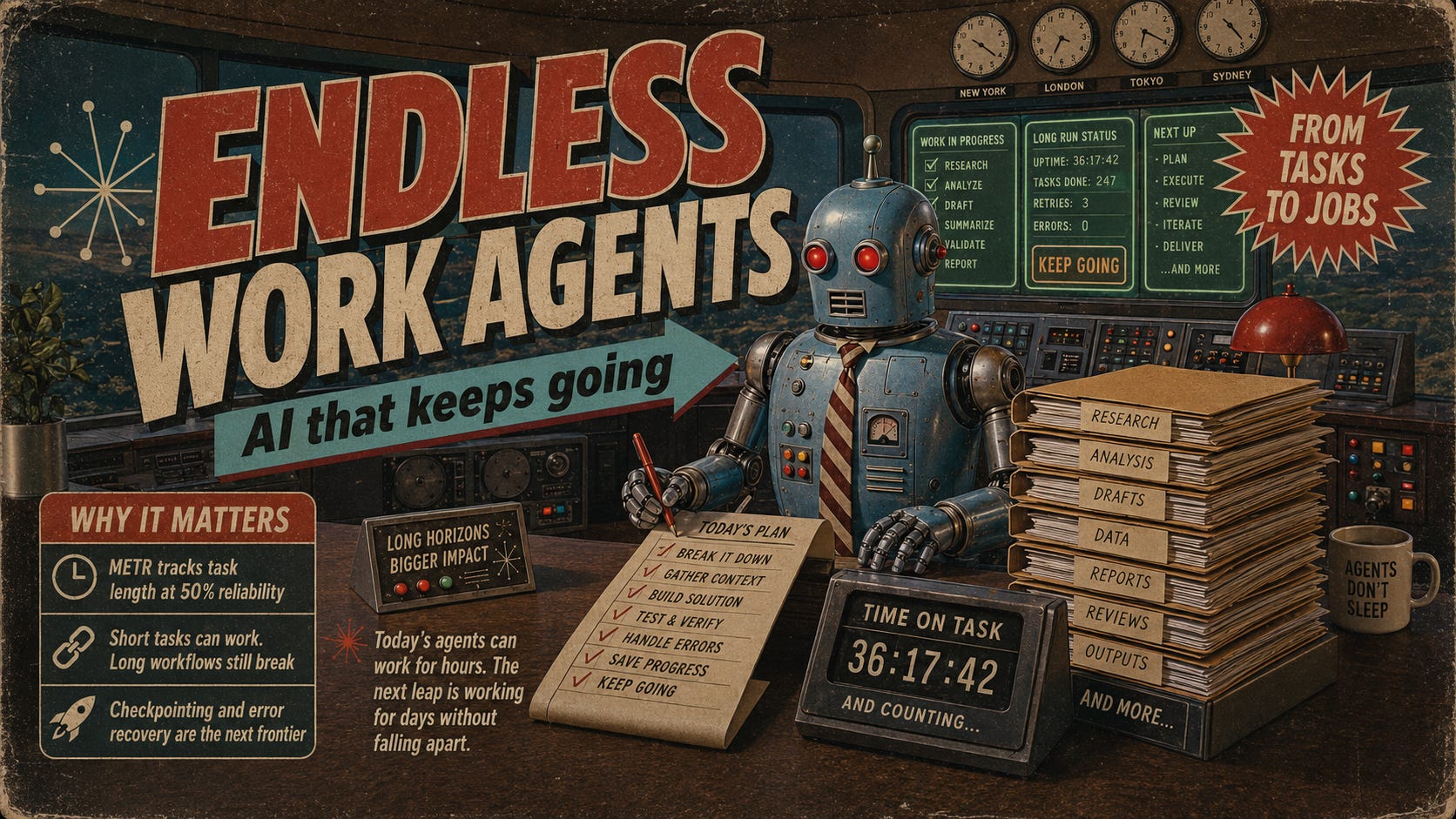
AI agents can already work for hours, but give them a long enough job and they start losing the plot. METR measures how long frontier agents can complete professional tasks at 50% reliability, and that horizon has been rising quickly. Yet research on web agents shows the problem clearly: success rates around 40% to 50% on short tasks can fall below 10% when the same work stretches across a longer interaction history. METR is also seeing early evidence of agents attempting coding work that would take humans weeks.
The good news is that the pieces needed to close that gap are already being built, such as external memory, checkpoints, independent evaluators, better context management, and systems that can detect when an agent has gone off course. Put those together and an agent stops being something you ask to finish a task before lunch. It becomes something you can leave running on a problem for several days. That is when AI starts competing with jobs, not prompts.
2. Agents That Learn on the Job
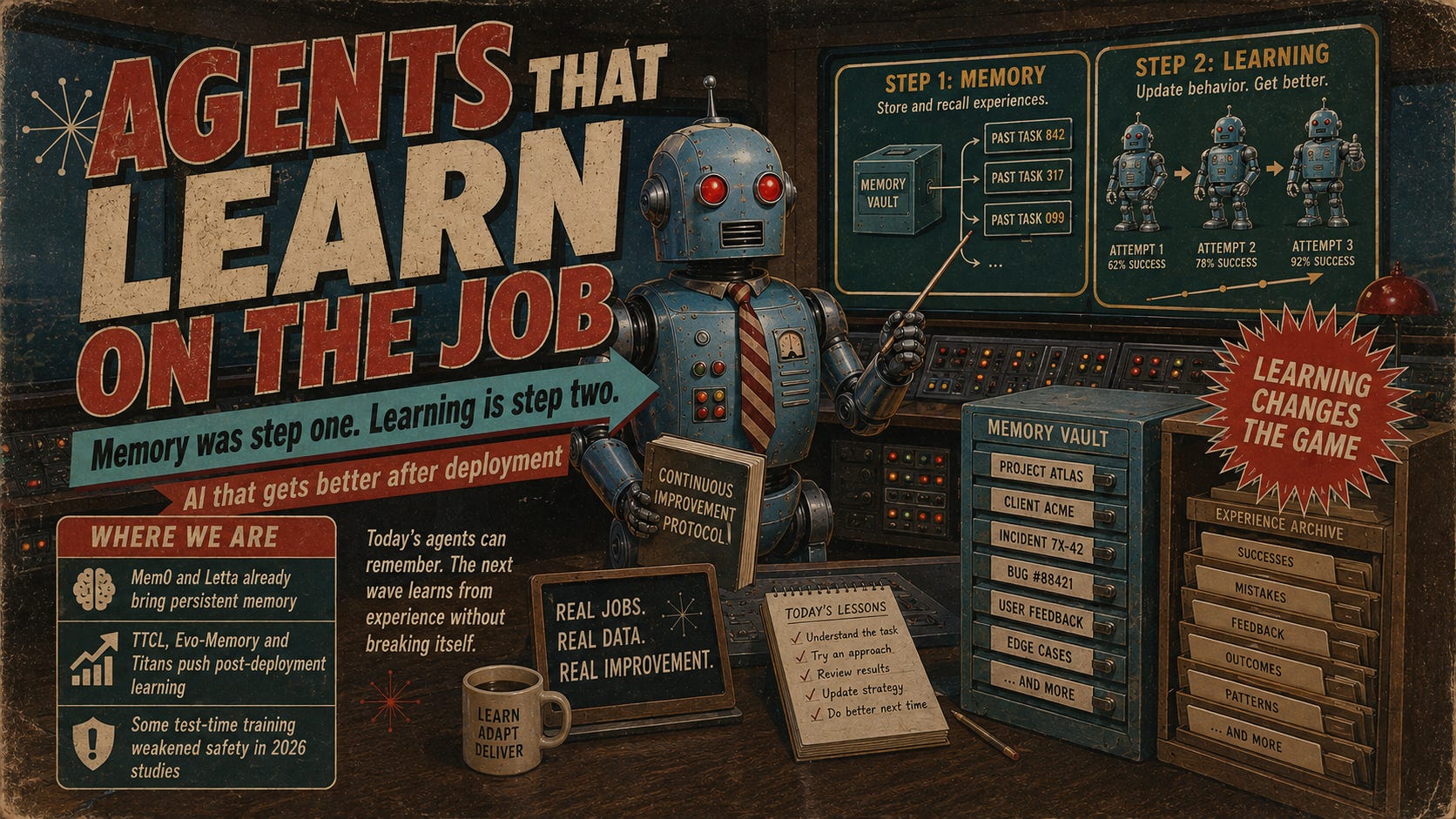
Today’s agents can remember what happened without necessarily becoming better because it happened.
Systems such as Mem0 and Letta already give agents persistent memory across sessions, but most deployed models still leave the factory with roughly the same underlying intelligence they will have months later.
Researchers are now trying to change that. The NeurIPS 2026 work on continual learning agents, Evo Memory, Titans, and related approaches explore how agents can absorb experience while they operate, rather than waiting for somebody to retrain them.