

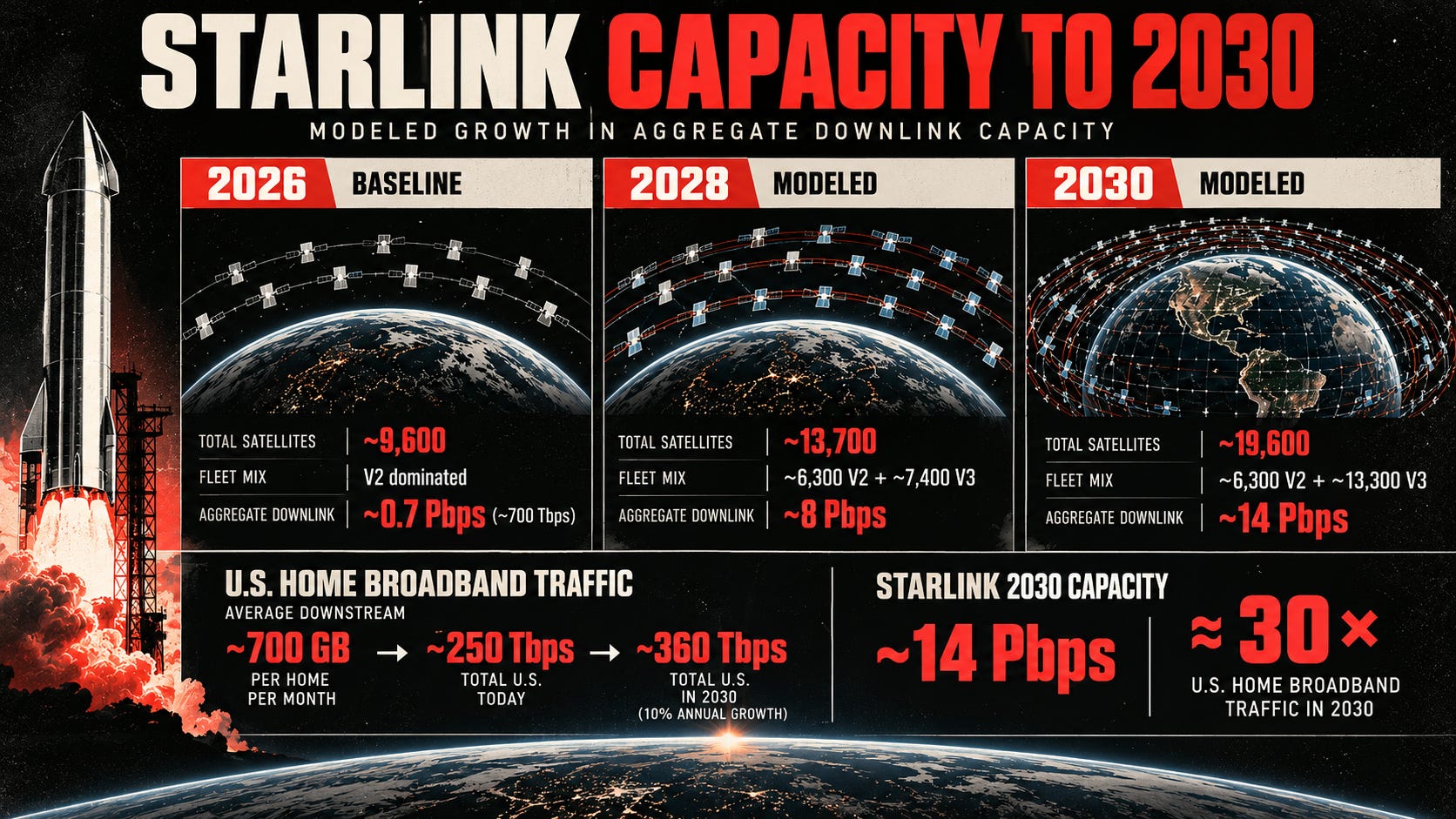
SpaceX had more than 700 Tbps of cumulative Starlink downlink capacity in orbit at the end of Q1 2026. But now, a mature Starship carrying 60 V3 satellites could add another 60 Tbps in a single launch. Put differently, about 12 full Starship loads could provide as much downlink capacity as the entire Starlink constellation did earlier this year.
That is a very different scaling model from the one the telecom industry has watched for the past five years. V3 is designed for 1 Tbps of downlink capacity per satellite, roughly 10 times that of V2. It also increases the number of downlink beams from 192 to 2,048, giving SpaceX much more freedom to reuse spectrum and move capacity toward areas with demand.
Extend that to 2030, and the numbers get large quickly. My scenario gets Starlink close to 14 petabits per second of aggregate downlink capacity, with about 13,300 V3 satellites in operation alongside part of the existing V2 fleet. That amounts to roughly 220 full Starship loads by the end of the decade, about 50 per year. It is an aggressive pace for a vehicle that has only just reached orbit, and a modest one next to the launch rates SpaceX says it is aiming for.
Even if Starship flies half as often, Starlink ends the decade with around 7 Pbps, ten times today’s constellation. At 14 Pbps, the old assumption that Starlink will always be confined to a small rural broadband market becomes very hard to defend. Measured against the evening peak of U.S. home broadband, it is enough capacity for about 20 Americas, although only a small fraction of it will ever be used in the United States. That fraction is the number telcos should be looking at.
Starship Changes the Capacity Math
Starship reached orbit for the first time this week and deployed its first 26 V3 satellites, which makes the new capacity outlook concrete. Each V3 is designed for 1 Tbps downlink and 160 Gbps uplink, and a full Starship load of 60 satellites adds roughly 60 Tbps of new downlink capacity.
That makes rocket cadence part of network planning in a way telcos are not used to seeing. Ten full Starship launches could add around 600 Tbps. Twenty could add 1.2 Pbps, and fifty could add 3 Pbps, assuming the satellites reach orbit and enter service as planned.
The satellite itself is also changing in ways that matter more than raw throughput. The jump to 2,048 beams in each direction, compared with 192 downlink and 144 uplink beams on V2, matters because satellite capacity is largely achieved through frequency reuse. SpaceX can reuse the same spectrum across sufficiently separated beams, rather than treating a few gigahertz as one giant shared pipe.
Spectrum therefore looks less restrictive than the conventional satellite broadband story suggests. In the United States, Starlink’s Ku-band user links include 10.7-12.7 GHz for downlink and 14.0-14.5 GHz for uplink. That gives it a 2 GHz downlink span and another 500 MHz on the uplink side, subject to the usual sharing and interference conditions. Gen2 also extends the architecture into additional Ka-band and higher-frequency resources.