

Three years ago, if someone had told me that a satellite broadband company would soon be sitting alongside some of the best-rated fiber providers in America in terms of customer experience, I probably would not have believed it. Fiber is simply a better access technology; It has more capacity, lower latency, symmetrical bandwidth, fewer spectrum constraints, and considerably more room for future upgrades. From a pure network engineering perspective, there is no debate.
Yet Starlink is now repeatedly appearing near the top of US broadband customer satisfaction studies, and not just in comparisons against other satellite providers. Customers are comparing the experience with fiber, cable, and fixed wireless, and in several studies Starlink is scoring surprisingly well. Satellite has not become technically superior to fiber.
These results suggest that the technology underlying the connection matters much less to customers than most people in telecom assume.
Starlink Is Now Competing With the Best-Rated ISPs
The latest CNET People’s Picks study gives Starlink an overall satisfaction score of 4.47 out of 5, compared with 4.20 for T-Mobile Home Internet and 4.16 for Verizon Fios. The reliability result is even more interesting. Starlink scores 4.59 out of 5, only slightly behind GFiber at 4.70. A few years ago it would have been difficult to imagine a satellite broadband provider being perceived as this reliable.
CNET is not the only study showing this pattern. CableTV.com surveyed more than 8,000 US broadband customers in 2026 and found that 89% of Starlink customers were completely or very satisfied, compared with 87% for Google Fiber and Ziply Fiber, with 86% saying they would recommend the service. The same study a year earlier reported 94% overall satisfaction with Starlink, so this does not appear to be a single-survey anomaly.
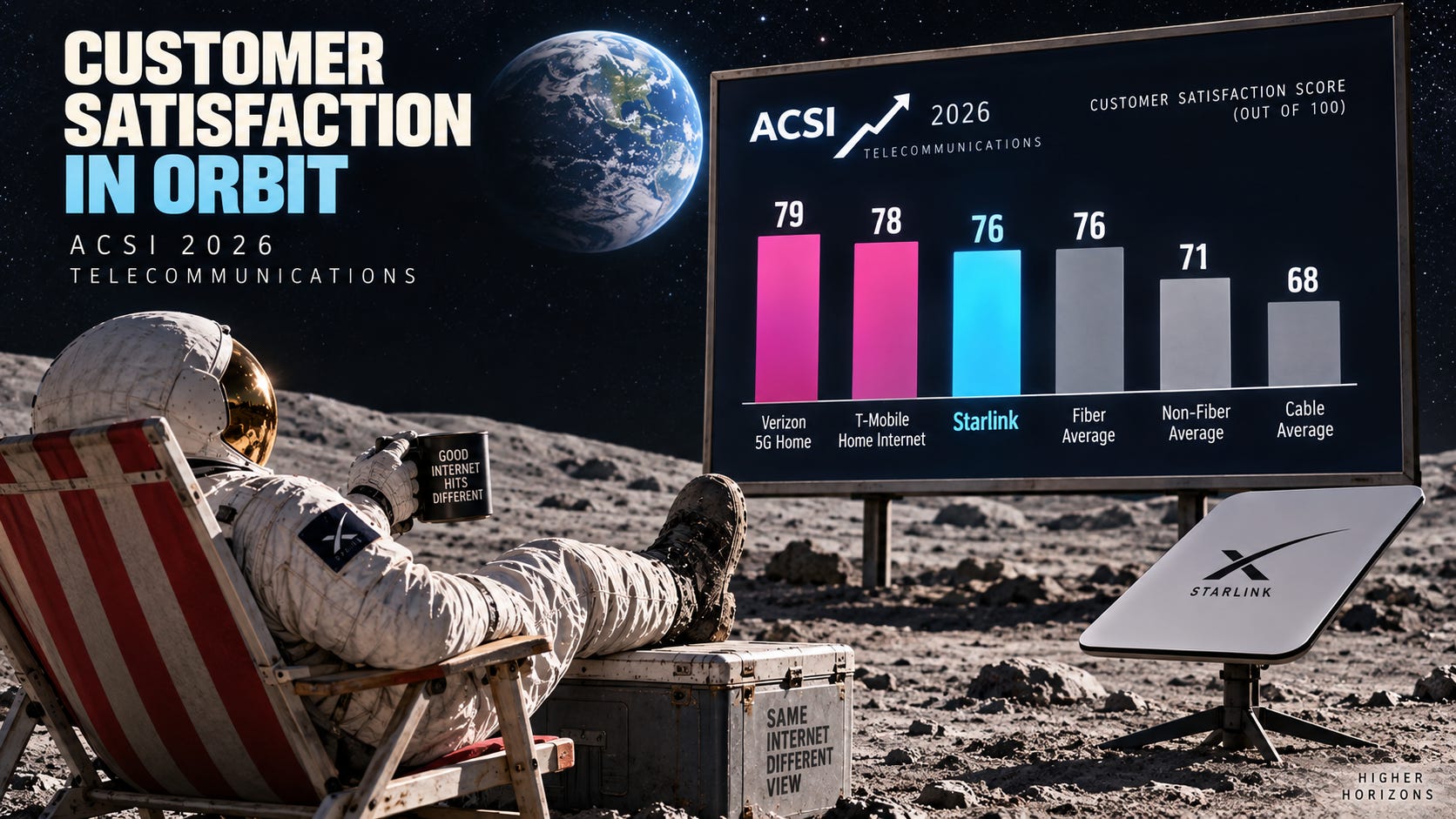
That pattern also shows up in the American Customer Satisfaction Index (ACSI), one of the longest-running benchmarks of US consumer satisfaction across major industries. Its 2026 telecommunications study, based on 26,963 customer interviews, is less dramatic but points in the same direction. Fiber broadband averaged 76 out of 100, while non-fiber averaged 71. Starlink debuted at 76, exactly matching the fiber average and finishing ahead of every major cable operator, even if Verizon 5G Home Internet and T-Mobile Home Internet scored slightly higher.
Recon Analytics was already seeing the same trend two years earlier, with Starlink achieving a Complete Experience component NPS of +42, compared with +18 for major fiber providers, +40 for large fixed wireless providers, and -2 for major cable providers. The more revealing moment came this August, during a Fiber Broadband Association webinar, when Roger Entner told the fiber industry’s own trade association that Starlink now has fiber-like reliability in customers' eyes and attributed it largely to the quality of the router. Yes, a trade body assembled to promote the superiority of fiber is being told that this superiority is no longer perceptible, and that the cause is a consumer electronics decision.
Although these studies use different samples, methodologies, and questions, and are not identical, it is difficult to ignore the consistency in their direction.