


Wall Street wiped tens of billions of dollars off the combined market value of Verizon, AT&T, and T-Mobile after SpaceX announced its latest spectrum acquisition. Investors are suddenly worried about Elon Musk building a fourth mobile operator in the United States. But I think another problem is developing, and it could affect the industry much sooner than most people expect.
The United States is preparing one of its largest spectrum release cycles in years, with at least 800 MHz covered by auction mandates extending through 2034. Verizon, AT&T, and T-Mobile will need to decide how much additional spectrum they require for 5G and eventually 6G, while SpaceX is assembling the assets to become a credible competitor in parts of the mobile market.
What interests me is how SpaceX could change the economics of those auctions. A new bidder with billions of dollars and a different network architecture could increase spectrum prices, force operators to defend strategic frequencies, and divert capital from other investments. But SpaceX could also reduce the value of certain spectrum assets because satellite connectivity changes the economics of conventional coverage.
SpaceX does not need to become another Verizon to hurt Verizon. And winning the next spectrum auction may not even be necessary.
The Next US Spectrum Auctions and the Billions at Stake
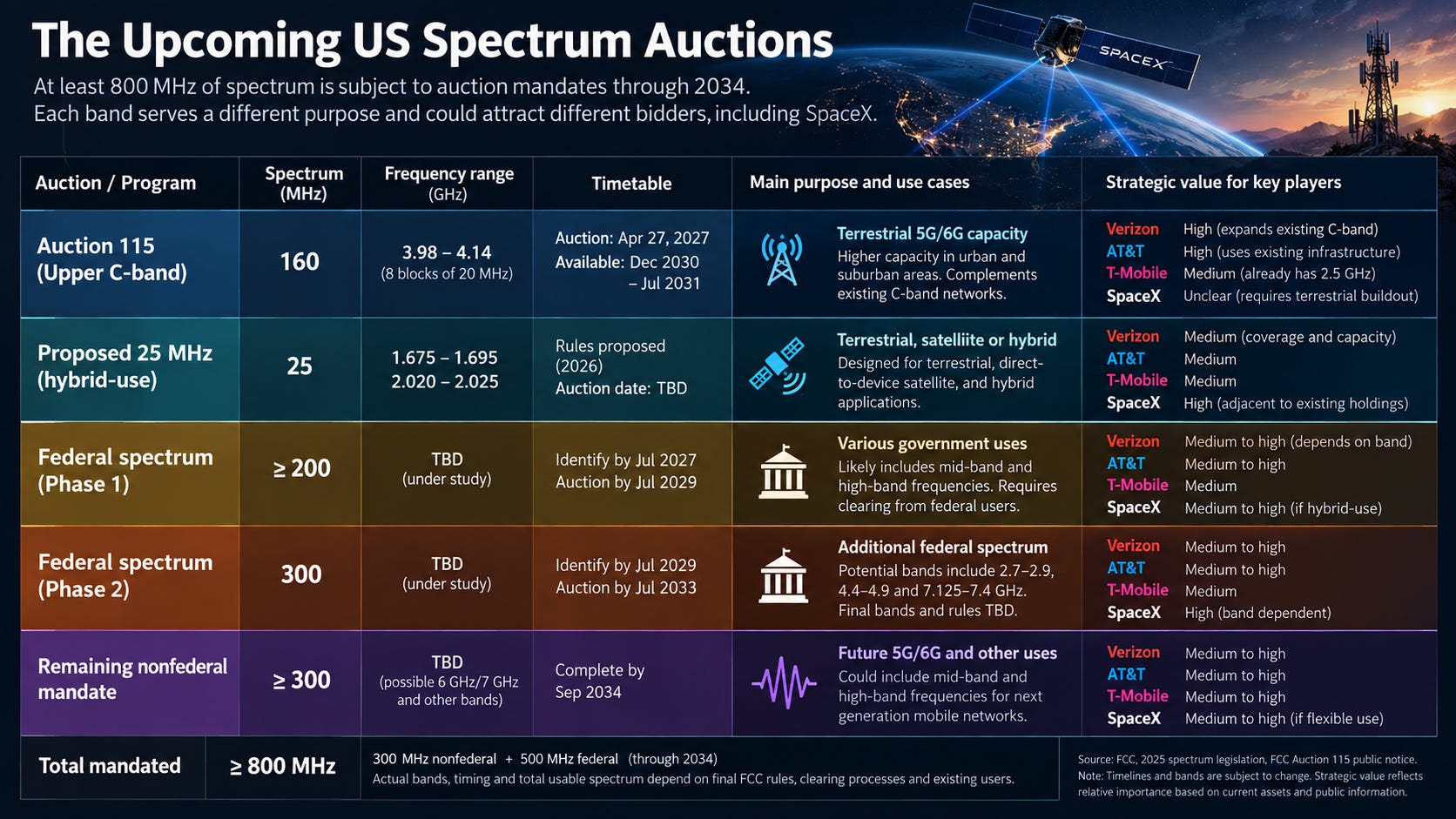
Congress restored the FCC’s spectrum auction authority in July 2025 and extended it through September 2034. The legislation requires auctions involving at least 300 MHz of nonfederal spectrum, including the Upper C band, and a separate 500 MHz of currently federal frequencies. These are substantial additions to the commercial spectrum pipeline, although the bands will become available at different times and under different technical conditions.
The first major event is Auction 115, tentatively scheduled for April 27, 2027. The FCC will offer 160 MHz between 3.98 and 4.14 GHz, divided into eight 20 MHz blocks across geographic markets. This is valuable terrestrial capacity spectrum, particularly for operators with existing C-band infrastructure.