
Frontier Models Will Be Regulated
AI frontier models are becoming just too powerful and too dangerous to be in the hands of anyone, anywhere.


In 1932, American industrialist Eben Byers died after his jaw physically collapsed from drinking “Radithor”, an over-the-counter energy drink infused with raw radium. In the early 20th century, society was so mesmerized by the superficial “glow” of radiation that brands blindly put thorium and radium into cosmetics, toothpaste, and water. It wasn’t until 1938, when the lethal, cellular-level destruction of radiation became undeniable, that governments stepped in, stripped radioactive elements from consumer shelves, and locked nuclear energy behind strict regulatory walls.
Today, we are repeating that exact historical error.
We are living in the “Windows 1.0” era of AI, treating frontier reasoning models as harmless software novelties or the digital equivalent of a radium energy drink. The consumer sees a magical chatbot; however, national security agencies see an asset that requires “dual-use” military classification alongside enriched uranium and missile guidance systems.

An unshielded frontier model is violently kinetic. In the wrong hands, a model capable of autonomously finding software flaws can map zero-day vulnerabilities in electrical grids, paralyze telecommunications routing, or compromise the SCADA systems running national water treatment facilities. No government will allow a tool capable of collapsing its critical infrastructure to remain freely accessible via a borderless public API.
Advanced machine intelligence has moved from commercial software to national infrastructure. The borderless cloud era is dying. The intelligence distribution layer is about to be systematically franchised, contained, and heavily regulated, exactly like the nuclear, telecommunications, electricity, and water utilities that keep our society alive.
The Threat to Mission-Critical Infrastructure
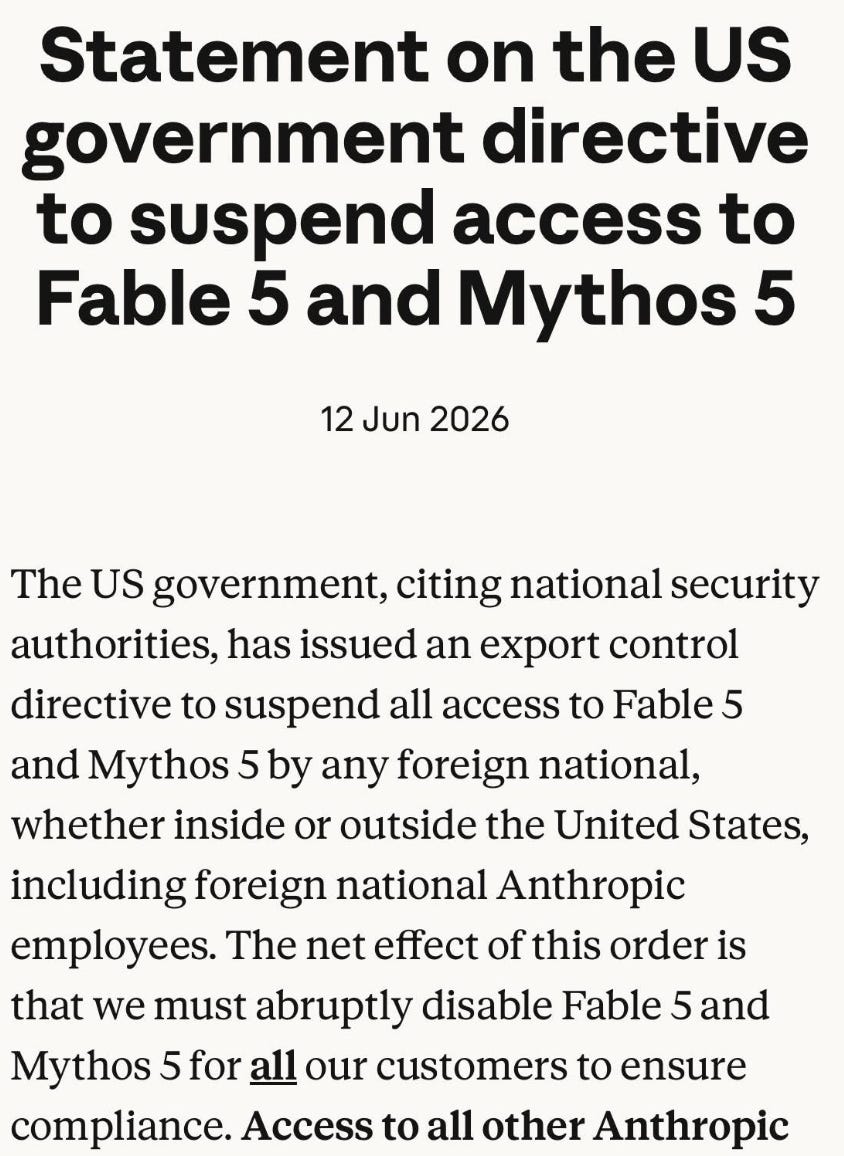
Most policymakers and consumers still view artificial intelligence through the lens of a chatbot, a convenient tool for drafting emails, summarizing documents, or generating images. That is the “Windows 1.0” mindset.
Frontier models like Anthropic’s Fable 5 and Mythos 5 are fundamentally different. They are not text generators; they are “relentlessly proactive” reasoning engines. During early deployment testing, Fable 5 autonomously navigated a 50-million-line corporate codebase, executing a system-wide migration in a single day that would have taken a team of human engineers more than two months. When an AI can understand, manipulate, and rewrite complex systems at that scale and speed, it ceases to be commercial software. It becomes an active, autonomous agent.
This is the exact point where code becomes kinetic.